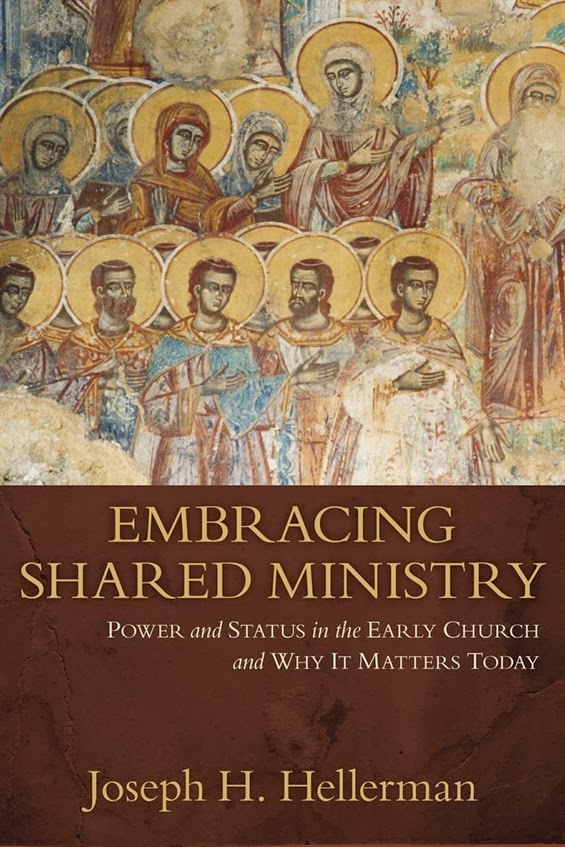
Embracing Shared Ministry: Power and Status in the Early Church and Why It Matters Today. By Joseph H. Hellerman. Grand Rapids, MI: Kregel Publications. 2013. 320 pp. (List price $17.99)
Joseph Hellerman offers profound insight into power and authority in first-century Roman society and the early church. He also offers some obligatory thoughts on their use in the church today. By far, the most important parts of this book are the first two sections dealing with Roman culture and the historical context of Paul's letter to the Philippians, a full 200 pages' worth.
When it comes to biblical interpretation, context is king. Understanding a biblical passage in light of its textual, historical, and cultural context is vital to achieving a personal understanding of the passage and correctly applying it to oneself and one's congregation. Hellerman's meticulous survey of power and authority, and specifically the honor culture, of Roman society in the first third of the book is solid gold. It squarely places the letter to the Philippians in context and provides detailed descriptions of Roman society that will help shed light on other passages and books in the New Testament. His descriptions of Roman parties and clothing as status symbols, drawn directly from first-hand accounts, will certainly color my reading of Paul's admonition to put off the old self and put on the new as well as James's admonition to not show partiality in the gathering of the church.
Further, his exegesis of key passages in Philippians in light of this historical context indirectly teaches how to apply historical and cultural context to our Bible reading, and directly expounds the Scriptures.
His last section on the church today left me a little disappointed, so I am basing my four-star review on the first two thirds of the book. This section did not have enough positive examples of church leadership to counteract the plethora of negative ones he gave. Additionally, he does not build strong link between this section and the first two, which seems to be a common problem for those of us with teaching ministries. It is necessary to highlight these links so others can arrive at the same conclusions.
Overall, I was blessed by the book, and plan on referencing it again and again for the historical perspective on Roman society.
I received a copy of this book from the publisher for the purposes of review.
Showing posts with label Biblical Interpretation. Show all posts
Showing posts with label Biblical Interpretation. Show all posts
Sunday, November 17, 2013


Friday, April 20, 2012
Book Review: The Freedom of Self-Forgetfulness
The Freedom of Self-Forgetfulness: The Path to True Christian Joy. By Tim Keller. Ross-shire, Scotland: 10Publishing, 2012. 48pp. ($4.99 Print—Amazon)
I’ve been seeing more short booklets recently based on sermons or lectures by some great expositors of Scripture. Tim Keller, author of King’s Cross and The Meaning of Marriage, is one of those expositors and this book comes from a message on 1 Corinthians 3:21-4:7.
Keller’s book looks at this passage in 1 Corinthians and shows how Paul addressed pride and humility in the context of our identity in Christ. Pride is fueled by comparing myself with others. Low self-esteem is fueled by comparing myself with others, which means it is the byproduct of pride unfulfilled. These issues are both caused by the same problem: we’re always trying to satisfy our ego, to prove ourselves.
The solution to pride and our inflated egos is humility as displayed in our own self-forgetfulness. Keller then takes his readers through the truth of the gospel, that in Christ we have no need for comparisons. The verdict of God comes before any performance on our part. Justification, then, is the solution to our ego problem.
Little books like this are helpful because they are quick reminders of truth and examples of how to approach a Bible passage.
I received a digital version of this book from the publisher in exchange for an honest review.
 |
| ««««« (four) |
Keller’s book looks at this passage in 1 Corinthians and shows how Paul addressed pride and humility in the context of our identity in Christ. Pride is fueled by comparing myself with others. Low self-esteem is fueled by comparing myself with others, which means it is the byproduct of pride unfulfilled. These issues are both caused by the same problem: we’re always trying to satisfy our ego, to prove ourselves.
The solution to pride and our inflated egos is humility as displayed in our own self-forgetfulness. Keller then takes his readers through the truth of the gospel, that in Christ we have no need for comparisons. The verdict of God comes before any performance on our part. Justification, then, is the solution to our ego problem.
Little books like this are helpful because they are quick reminders of truth and examples of how to approach a Bible passage.
I received a digital version of this book from the publisher in exchange for an honest review.
Tuesday, April 17, 2012
Book Review: Bad Girls of the Bible
From Hannah:
Bad Girls of the Bible is an entertaining, compassionate look at the lives of ten Biblical women who were known for their sinful behaviors. Higgs writes a fictional, modern-day account of each story then examines the biblical text, evaluating each woman’s actions and place in the story.
 |
| ««««« (three) |
Although I found the book interesting, the author focused on the women to the exclusion of the main point of the bigger story they are a part of. The story of Joseph and Potiphar’s wife isn’t primarily about Potiphar’s wife. It is about Joseph’s commitment to follow the Lord and ultimately shows God’s provision for His chosen people through Joseph’s trials in Egypt. Potiphar’s wife plays an important role in that story, but instead of talking about how God used even her sinful actions to place Joseph in a situation where he could eventually gain an audience before Pharaoh, Higgs speculates about the woman’s motives, lifestyle, and even her clothing. Devoid of the purpose of each woman in the great context, this book turns the Bible into a compendium of morality tales.
I would instead recommend Beth Moore’s Bible study on Esther for an in depth look at a Biblical woman that appropriately looks at the person in light of the overall story. For an overview of Biblical women, I would recommend Elizabeth George’s The Remarkable Women of the Bible or John MacArthur’s Twelve Extraordinary Women.
I received this book from the publisher for the purpose of review.
Tuesday, November 1, 2011
What are You "Singing" about God?
"As the church’s hymnbook often serves as the theology text for the average layperson, it is instructive how much robust theology we find in the hymnbook of the ancient Israelites."
"Why, then, are the psalms absent in many modern churches? Repetitive praise choruses are substituted for the reading or singing of the psalms. When psalms are used, only short selections are read. Difficult verses and entire psalms are ignored."
Plummer, Robert L. (2010-04-22). 40 Questions about Interpreting the Bible. Kregel Pubn. Kindle Edition.
Monday, September 12, 2011
The Bible isn't About "Me"

Do you read the Bible with a “me” focus? Ultimately we want to understand what we’re reading and bring our lives in conformity with what the Word says. But that’s not the “me” focus I’m talking about.
I’m talking about a “me” focus that ignores the original intentions of the biblical author and the circumstances of the writing, heading straight for my personal application.
For instance, say you read Jeremiah 29:11—“For I know the plans I have for you, declares the Lord, plans for welfare and not for evil, to give you a future and a hope.” As you pass over this verse, you immediately apply it to your life. God has a plan for me. He doesn’t want anything bad to come to me and I have a hope and a future in Christ. I’m not saying those things aren’t true, but is that really what this verse is saying?
This verse was written to a group of people living in exile in Babylon. They left as captives of war and now had formed their own communities under the rule of the pagan king Nebuchadnezzar. God, through Jeremiah, was calling them to seek the welfare of their new city and their captors. He was promising them that after the exile they would return to the land of Israel. It was a temporal promise that was fulfilled in their time. The promise was for them, not for us.
By taking the focus off of “me,” we can better understand what the Bible says and only then can we begin to apply it to our life. In this case, even though the promise was fulfilled, does it not point to a greater reality that God takes care of His people? Instead of claiming this verse as a future promise for us, we should claim it as a past exhibition of God’s faithfulness and a reminder that God will continue to be faithful to us in the future. This promise in Jeremiah 29:11, a temporal promise, prefigures the kind of promise we have in Christ, specifically Romans 8:28-30,
And we know that for those who love God all things work together for good, for those who are called according to his purpose. For those whom he foreknew he also predestined to be conformed to the image of his Son, in order that he might be the firstborn among many brothers. And those whom he predestined he also called, and those whom he called he also justified, and those whom he justified he also glorified.

Recommended resources: 40 Questions About Interpreting the Bible by Robert Plummer

Friday, August 12, 2011
Who is Lucifer?
Everyone knows that Lucifer is another name for Satan, the Devil. Yet if you go to Biblegateway and look for it, chances are you’ll have to go through a few translations to find it. That’s because modern translations have chosen to render the verse, Isaiah 14:12, a little differently. The King James Version has it thus:
How art thou fallen from heaven, O Lucifer, son of the morning! how art thou cut down to the ground, which didst weaken the nations!

It’s a veritable “in your face”. Though the context shows that Isaiah’s message was for the King of Babylon, many would agree that this is part of a slam on the one working behind the scenes. God is mocking Satan.
Yet the word here could also be rendered “shining one” or “morning star”. In the Latin Vulgate, translated by Jerome in the 4th century, the word selected was Lucifer, which was maintained when translators were working on the King James Bible in the early 1600s.
Yet we do not really understand the passage if we believe Lucifer or even “morning star” is Satan’s proper name.
The morning star, a literal object in the night sky we know as Venus, was associated with the coming of the dawn, making it the “light bearer”. The point God is making through Isaiah the prophet is that Satan is not the light bearer. God is mocking him—a kind of ancient sarcasm, if you will.
Think back to Han Solo’s remark to his old “friend” Lando Calrissian in Star Wars: The Empire Strikes Back when he says “You’re a real hero,” after Lando betrays him. Lando was not a hero in Han’s eyes. Likewise, Satan was not the “morning star” in God’s eyes.
The real morning star was none other than Jesus Christ. Though “morning star” is used in other places in the New Testament to refer to Jesus, none is as clear as Revelation 22:16,
“I, Jesus, have sent my angel to testify to you about these things for the churches. I am the root and the descendant of David, the bright morning star!” (NET)
Perhaps because of the association between “Lucifer” and Satan, some modern translations do not use the same word or phrase in Isaiah 14:12 and the other New Testament references. The ESV uses “day star” in the Isaiah passage and “morning star” in the others. The NASB uses “star of the morning” and “morning star”, which is much closer. Others use the same phrase but add a different adjective, such as “shining morning star” and “bright morning star”.
Regardless, the real morning star is Jesus Christ, not Satan. Though technically “Lucifer” should be a moniker for Christ, it still has an association with Satan in the minds of believers and unbelievers alike. Telling your friends that Lucifer is really Jesus would probably confuse them and you’d be called a heretic. Instead, we should do away with the old Latin word and stick with “morning star”, “day star”, or “star of the dawn” and emphasize the true bringer of light, Jesus Christ.
Thursday, August 11, 2011
Why do Some Say that Women Shouldn't be Pastors?

Today it is very easy to find a woman who is charged with the leadership and teaching of a church. They write books and have ministries on the television and the internet. There are thousands of people—men and women—who affirm that they have been blessed through the ministry of a “woman pastor”.
Opinions about this topic can’t be based on our experiences. There are people who have had good and bad experiences with women pastors—who can say that one experience is more or less valid than another?
The basis of our belief must be the Bible, whatever it teaches.
I believe that the Scriptures are clear: the pastorate is reserved for men. I am going to give you some reasons why I think so and some implications of this interpretation.
Reasons why
1) Paul did not permit it. First Timothy 2:11-12 says, “Let a woman learn quietly with all submissiveness. I do not permit a woman to teach or to exercise authority over a man; rather, she is to remain quiet.” (ESV).
Some misinterpret this verse to repress women and not let them say even one word in the church. But if Paul didn’t permit women to speak at all, why does he speak of women praying and prophesying in 1 Corinthians 11:5? It isn’t that women can’t speak, but that they can’t teach or exercise authority over a man.
The pastor not only teaches the congregation, but exercises authority. The act of teaching is exercising authority. The pastor is responsible for the congregation—he has to care for it like a flock of sheep and one day will appear before God to give account for his flock (see 1 Peter 5:2; James 3:1).
If you continue reading verses 13 through 15 in the 1 Timothy passage, you will find Paul’s reasoning: it was God’s order. He chose the man to be the leader of the family and also the church.
2) There are no women pastors in the New Testament. Read it. You won’t find any woman who is a pastor. In our day we have women pastors so we have to distinguish between men and women. In that day the women didn’t even receive an education. If Jesus and his disciples weren’t afraid of doing things against the culture like teaching women as disciples (Luke 10:39), why is it that they didn’t ordain women as pastors if they thought that the pastorate was for women just as it is for men?
In two passages (1 Timothy 3; Titus 1) Paul gives us the requirements for pastors. En both he says that he must be “husband of one wife”. Even though it is possible that this is an idiom that means “faithful to his wife,” the supposition is the same: Paul assumes that the pastor is a man.
It is interesting that Paul calls Phoebe a “deacon[ess]” in Romans 16:1 because in 1 Timothy 3 he gives us the requirements for the deacons and “the women”. If he is referring to deaconesses and not the wives of deacons, it is very curious that he doesn’t refer to women pastors here.
The woman pastor is a very recent phenomenon in the history of the church. I don’t believe that it is a good development that the apostles and the first Christians overlooked. I believe that it is a deviation from the biblical norm.
The woman pastor is a very recent phenomenon in the history of the church. I don’t believe that it is a good development that the apostles and the first Christians overlooked. I believe that it is a deviation from the biblical norm.
What it doesn’t mean…
There are some important implications if being a woman pastor is against the Bible, but I want to start with what it doesn’t mean:
1) Above all, it doesn’t mean anything about the character, value, understanding, or importance of women. Many women are more noble, intelligent, and wise than I. God chose the man to be the leader of the home and leader of the church. Women shouldn’t focus so much on what God denies them, but rather on all the ministries in which they can serve.
2) It doesn’t mean that women can’t teach or have authority over a man outside of the church. These rules are for the church. There are many women who are managers, police officers, teachers, and even presidents. I can’t deny them the respect they deserve from their position and must submit to them if necessary.
3) It doesn’t mean that women pastors aren’t Christians. It is very easy to judge the motivations and the character of a person just because of a false teaching. The truth is that all of us, including me, make mistakes in our interpretation. No one should support an interpretation they know to be false, but we will always be blind to certain things.
Certainly there are women pastors who aren’t Christians, who intentionally obscure the truth and are intentionally in rebellion against the Word of God. The only thing that we can do is show them the truth, let the Holy Spirit work in their lives, and help others to know the truth so they can attend a more biblical church.
4) It doesn’t mean that women pastors don’t understand the Scriptures. Like I said before, everyone makes mistakes, we just don’t see it. One person can have a mistaken interpretation about one passage but the correct interpretation about another. There are many people who have been blessed by women pastors. But we need to be biblical and the end (the blessing) does not justify the means (women in the pastorate).
5) It doesn’t mean that a woman can never teach a man. My wife has taught me much about God and the Word. The Bible also records an instance when Pricilla and her husband (together) taught Apollos about the Word of God (Acts 18:24-26).
What it does mean…
1) The women who “felt a call” to the pastorate are mistaken. The basis of our beliefs has to be the Bible, not feelings or experiences. I don’t believe that all women who are pastors are sinning intentionally. I believe that they have let the values of this world (independence from men, disdain for submission, and dishonor of being a mother) transcend their process of interpreting the Bible.
2) A believer should not attend a church that is pastored by a woman. God is not capricious—He has a reason for giving us the roles He did. The faithfulness of a church with a qualified pastor is worth more than the popularity of a church with a woman pastor.
3) We must think a lot about the positions of authority and teaching in the church. Can women teach a class with men? Teenage males? Young boys? In my opinion, a woman should not be charged with a class if there are men in it. But there is a difference between a man and a child. So the difficulty for most people will be deciding if the youth leader should be a man or if women can do it also.
4) Men have to develop the desire to be spiritual leaders in church as at home. If all of us studied the Word, prayed to God, and sought to reach the requirements of being a pastor, no woman would be able to take up that position.
May God help you submit to His Word, guided by the Spirit, and to play your role in the church and in your home.
Monday, July 25, 2011
Back to School Again!

In the next couple of weeks I will be making an announcement about some changes in my regular activities, but my plate is still going to be full, I can guarantee you that! I was looking over my course options for this semester and I decided to take Biblical Hermeneutics. That's a fancy way of saying "How to Interpret the Bible." I've even started on the lectures (see the above screenshot of my notes and lecture video).
I believe very strongly that an individual will learn to interpret the Bible based on how biblical truths are presented to them: through books, classes, but most importantly, the pastor. I was fortunate to have a Bible-believing pastor during my early formative years who knew how to explain passages and show how words and phrases came together within the whole of the Bible to communicate with us today. As a result I'm usually pretty good at finding the right interpretation of a passage (or at least admitting my inability to do so when I can't).
I believe this class will help me, both with teaching and preaching, as I continue to minister in, with, and among Enfoque, the Hispanic ministry of Fall Creek Baptist Church.
Knowing how to interpret and apply the Bible is vital for every believer. Too many of us want to jump right to application and ask "What does this passage say to me?" before they even consider what the author's original intention was. From what I've seen, my required textbooks are ones I'm going to keep in my library.
If you need to brush up on your skills of biblical interpretation, I suggest checking out some of these books:
Hermeneutics: Principles and Processes of Biblical Interpretation
A Basic Guide to Interpreting the Bible: Playing by the Rules
40 Questions About Interpreting the Bible (40 Questions & Answers Series)


I may be sharing a few thoughts about the books and the class throughout the semester, so stay tuned.
Friday, July 15, 2011
The "Body of Death" Myth

Sunday, February 6, 2011
Fleeing or Enduring Persecution? (part 3)
This is part two of a three part blog posting on the believer's response to persecution. Read parts one and two.

What the Bible Says
As helpful as Christians from the first few centuries of the church can be, we must ultimately derive our beliefs from the same book they had access to: God’s Word.
Although biblical narratives can present the facts without weighing in on whether the actions of the people described were right or not, the Book of Acts details some narratives we should take into consideration.
For one, when Saul had converted in Damascus and began preaching boldly, his opposition planned to kill him. When Saul’s disciples discovered this, they “took him by night and let him down through an opening in the wall, lowering him in a basket” (Acts 9:25).
Saul was still new to the faith, as were his disciples, so it is possible they were wrong to flee persecution. But there are more examples to consider.
A few verses later we find Saul in Jerusalem. He argues with the Hellenists, who may have been part of the same synagogue that he was and that killed Stephen. They in turn plot to kill Saul. The passage then reads, “And when the brothers learned this, they brought him down to Caesarea and sent him off to Tarsus” (Acts 9:30).
The possibility of the believers being wrong in this action is very slim. First, there is no dissention mentioned. The believers are described as unified in sending Saul off, and both Barnabas and the apostles are mentioned as being present and having met with Saul in verse 27. Their consent is quite likely implied, and after fleeing and abandoning Christ in the garden, it is quite unlikely that they would encourage Saul to flee if they viewed fleeing persecution the same way as abandoning and denying Christ.
But perhaps Jesus’ statement helps shed more light on the actions of Saul and the believers in Acts 9. He says in Matthew 10:23, “When they persecute you in one town, flee to the next, for truly, I say to you, you will not have gone through all the towns of Israel before the Son of Man comes.”
The greater context shows Jesus speaking to the twelve prior to sending them out. The context also shows that these words were not just specific to that one “mission trip” of the disciples, but referred to the time after the church was established, since He also says,
Although the Bible has much to say about persecution and martyrdom, I have to be brief here. I have not argued that fleeing persecution is the only appropriate response. As for those in Egypt, some will stay and some will go. Some may die for the faith. We need not second-guess every missionary’s decision in this matter, but we should pray that they would be submissive to the leading of the Holy Spirit.

What the Bible Says
As helpful as Christians from the first few centuries of the church can be, we must ultimately derive our beliefs from the same book they had access to: God’s Word.
Although biblical narratives can present the facts without weighing in on whether the actions of the people described were right or not, the Book of Acts details some narratives we should take into consideration.
For one, when Saul had converted in Damascus and began preaching boldly, his opposition planned to kill him. When Saul’s disciples discovered this, they “took him by night and let him down through an opening in the wall, lowering him in a basket” (Acts 9:25).
Saul was still new to the faith, as were his disciples, so it is possible they were wrong to flee persecution. But there are more examples to consider.
A few verses later we find Saul in Jerusalem. He argues with the Hellenists, who may have been part of the same synagogue that he was and that killed Stephen. They in turn plot to kill Saul. The passage then reads, “And when the brothers learned this, they brought him down to Caesarea and sent him off to Tarsus” (Acts 9:30).
The possibility of the believers being wrong in this action is very slim. First, there is no dissention mentioned. The believers are described as unified in sending Saul off, and both Barnabas and the apostles are mentioned as being present and having met with Saul in verse 27. Their consent is quite likely implied, and after fleeing and abandoning Christ in the garden, it is quite unlikely that they would encourage Saul to flee if they viewed fleeing persecution the same way as abandoning and denying Christ.
But perhaps Jesus’ statement helps shed more light on the actions of Saul and the believers in Acts 9. He says in Matthew 10:23, “When they persecute you in one town, flee to the next, for truly, I say to you, you will not have gone through all the towns of Israel before the Son of Man comes.”
The greater context shows Jesus speaking to the twelve prior to sending them out. The context also shows that these words were not just specific to that one “mission trip” of the disciples, but referred to the time after the church was established, since He also says,
Beware of men, for they will deliver you over to courts and flog you in their synagogues, and you will be dragged before governors and kings for my sake, to bear witness before them and the Gentiles. When they deliver you over, do not be anxious how you are to speak or what you are to say, for what you are to say will be given to you in that hour. For it is not you who speak, but the Spirit of your Father speaking through you. Brother will deliver brother over to death, and the father his child, and children will rise against parents and have them put to death, and you will be hated by all for my name’s sake. But the one who endures to the end will be saved (Matt 10:17-22).
Although the Bible has much to say about persecution and martyrdom, I have to be brief here. I have not argued that fleeing persecution is the only appropriate response. As for those in Egypt, some will stay and some will go. Some may die for the faith. We need not second-guess every missionary’s decision in this matter, but we should pray that they would be submissive to the leading of the Holy Spirit.
Thursday, January 20, 2011
It's Not Easy Being Green

Kermit the Frog said, “It’s not easy being green.”
I am green. By that I mean I am young and inexperienced. I lack much of the ministry experience (and life experience) of my fellow contributors on sbcIMPACT.org, and if word got out how old I actually am, they might take away my blogger’s license and hand me a Hello Kitty Journal and ask me to get back in touch with them in a few years.
Okay, maybe not. But I am green.
Probably from the time I was twelve I was told about the great motivational Bible verse for young people: “Don’t let anyone look down on you because you are young, but set an example for the believers in speech, in life, in love, in faith and in purity” (1 Timothy 4:12, NIV©1984).
This verse was not just on my lips and in my mind. Others were quoting it as well. Even pastors were talking about how Timothy was only around 17 when he became a pastor.
This was all great except for one thing: Timothy was not 17. In all reality, he was probably in his mid-late thirties when he received this letter from Paul.
The first we hear of Timothy is in Acts 16 when he joins up with Paul on his second missionary journey, though he was probably converted in Lystra during Paul’s first trip. That conversion may have occurred somewhere around 48 A.D. The second trip was around 50 A.D. The letter to Timothy was written sometime around 64 A.D. Even if Timothy was 16 when he became a Christian, he would have been a minimum of 32 years old when 1 Timothy was written. The point of all this is that hoping people will someday not look down on me because of my age is pointless.
I know a pastor who said that he always thought people would respect him when he turned thirty. Thirty came and went. Then he thought that when he turned forty, people would respect him. I think he’s gotten over that delusion.
Each of us probably feeds a similar delusion. Sometimes it’s the belief that one day I’ll be respected for my age. Or people will listen to me when I have kids of my own. Or once I get a college degree I’ll have more influence.
1 Timothy 4:12 does not teach us that one day people will look up to us once we’ve arrived at some goal or life event. It teaches us that people are going to look down on us simply for who we are. The challenge, then, is to set an example anyway “in speech, in love, in faith and in purity.”
Subscribe to:
Posts (Atom)