Showing posts with label Reformation Trust. Show all posts

Sunday, November 18, 2012

Book Review: Are We Together? #RomanCatholicism

Are We Together? A Protestant Analyzes Roman Catholicism. By R.C. Sproul. Sanford, Florida: Reformation Trust Publishing. pp. 125. 2012. ($17.00 Hardcover)


Five Stars | Highly Recommended!
The Roman Catholic Church claims more than one billion adherents. As a Protestant, that’s not something I can overlook. Are we all of one faith, with our own particular differences and idiosyncrasies, but a common gospel? The Reformers who birthed Protestantism came to the conclusion that Rome had departed from the biblical gospel. Are things different today?

R.C. Sproul sets out to answer that question with his book Are We Together? A Protestant Analyzes Roman Catholicism. It’s no surprise that Sproul doesn’t think we are together, and each of his chapters address the six main points of difference between Protestantism and Roman Catholicism. This is probably his biggest service to readers, focusing on the main issues and not addressing each and every point of difference ad nauseum.

His chapters are:
  1. Scripture
  2. Justification
  3. The Church
  4. The Sacraments
  5. The Papacy
  6. Mary
It is in the chapter on Mary (which was also the most interesting chapter) that Sproul summarizes the greatest difference between the Roman Catholic Church and Protestantism:
The biggest issue in the whole Mariology debate is the sufficiency of Christ. In truth, this is the issue with Roman Catholic theology from beginning to end. It is the issue with Rome’s doctrine of Scripture, its doctrine of justification, and even here, with its doctrine of Mary. Is Christ alone our perfect sacrifice? Does He offer Himself for the sins of His people or is He offered by His mother? Does He alone achieve our redemption or does He have to depend upon the cooperation of His mother? Protestants believe that Christ alone is our justification. (p.115)
It is vitally important that Protestants like myself really understand what the sufficiency of Christ really means and how this differs from Roman Catholic teaching. Although any random person who self-identifies as Roman Catholic may or may not know or believe the official doctrines of the Roman Catholic Church, Protestants should be aware of what they themselves believe. This is a good introduction to this very important issue, and I highly recommend it, especially for those who work with and minister to those who claim to follow Rome.


I received this book from the publisher for purposes of review.

Thursday, May 17, 2012

eBook deal: Feed my Sheep for 99¢

I'm a big fan of ebooks. Ever since I got my Kindle Touch for Christmas, I've been using it almost daily for reading my Bible, required texts for my classes, and even listening to audio books. I subscribe to a number of blogs that point out deals and freebies for the Kindle, which is how I got our current small group book, Crazy Love, for free.

I've enjoyed some titles from Reformation Trust publishing, and right now they are having an ebook deal (available for both Kindle and ePub readers) on the book Feed my Sheep: A Passionate Plea for Preaching. I've written a review of it before, and at 99¢ it is a steal. Since I already have it, I won't be jumping on this offer myself, but I will wait in eager anticipation for the next deal from Reformation Trust.

Monday, March 28, 2011

Book Review: Slave by John MacArthur

Editor's Note: My wife, Hannah, previously reviewed the print version of this book. I recently received the audio book and my review pertains to that format.

I’ve read a book or two by John MacArthur and have enjoyed both his Study Bible and radio program for some time. My wife read and reviewed the print version of Slave, so when I had the opportunity to review the audio book, I figured it was time for me to try it as well.

The concept behind Slave is a good one. We need to be reminded just what it meant to be a slave of Christ, and since most translations prefer “servant,” MacArthur does well to remind us just what it meant to be a slave in the first century (with important comments on the slave trade in British and American history). My favorite chapter described the life of Jan (John) Huss was a fantastic overview of his life.

The book was a little disjointed and at times it seemed like MacArthur was forcing connections back to slavery where there were none. Early on he mentions that he was originally asked to write about the doctrines of grace, so he kind of blended the two themes together when they would have been better done separately.

Still, the recognizable voice of MacArthur makes a great reading companion and the gems in the book are worth looking at. I just wish they could have been a little more polished.

To buy this book, visit ChristianAudio (direct link).
To buy a hard copy, visit Amazon.com.
To look at a PDF excerpt, click here.

Disclosure of Material Connection: I received this book free from ChristianAudio as part of their Blogger Review Program. I was not required to write a positive review. The opinions I have expressed are my own. I am disclosing this in accordance with the Federal Trade Commission’s 16 CFR, Part 255: "Guides Concerning the Use of Endorsements and Testimonials in Advertising."

Monday, March 7, 2011

Book Review: Holy, Holy, Holy: Proclaiming the Perfections of God

Holy, Holy, Holy is an anthology with each chapter coming from some well-known names in Reformed theology. As with most any anthology, there are some authors and subjects that are better than others, and I find my biases beginning to firm up as I sampled some names before in Feed My Sheep: A Passionate Plea for Preaching.

Chapter 2. “Hallowed Be Your Name”: The Holiness of the Father
After a helpful introductory chapter by R.C. Sproul, the book hits full force with a powerful chapter by Sinclair Ferguson. Having read his book The Holy Spirit, it was no surprise that Ferguson powerfully captures the reader with the marvelous and mysterious unity between the Father and Son.

Chapter 4. “The Breath of the Almighty”: The Holiness of the Spirit
It felt like Alistair Begg attempted to cover too much material in one chapter. I would have enjoyed a more focused treatise than the one provided (of course, I could be biased having read Ferguson’s earlier work). Begg spent too much time on the relationship between the Father and Son and on the identity of the Holy Spirit. His textual link between the Holy Spirit’s role of convicting the world of sin, righteousness, and judgment with the thief on the cross was a hint at what the whole chapter could have been and should have been.

Chapter 6. “A Holy Nation”: The Church’s High Calling
Whenever I read D.A. Carson’s work I get the terrible feeling that I don’t know anything about hermeneutics. Though one of the world’s greatest Greek scholars, he doesn’t have to take you back to the root meaning of an obscure word to show you what the text means, and the result is a superbly written piece that teaches, encourages, and challenges you to take a closer look at a passage before moving on to the next.

Chapter 7. “Wounded for Our Transgressions”: The Holiness of God
This chapter takes a look into the book of Isaiah to draw out some of the passages dealing with Christ’s substitutionary death for us. The author, W. Robert Godfrey, makes an interesting compare and contrast analysis between King Uzziah’s sin, leprosy, and death (Isaiah 6:1) and Jesus. He reads leprosy into the passage more than I am comfortable with, sounding more like eisegesis than exegesis. I would urge others to be careful to take the passage at face value and not seek some hidden meaning (like my friend who thought the book of Philemon was an allegory about receiving Christ as Savior).

Each author adds his own perspective and style. The diversity can keep things from droning on too long, but I was more often left wanting more. A book like this provides a helpful glimpse into the minds of some great thinkers and authors, and I find anthologies much like a compilation music album: just enough to give me an idea of who I want to read more at length later. Specifically, I will keep my eyes open for more from Ferguson, Anyabwile (ch. 5), Carson, and Thomas (ch. 8).

To buy the book, visit Ligonier.org (direct link).

If you're interested, but not sure, download a copy of the first chapter here.
Disclosure of Material Connection: I received this book free from Reformation Trust Publishers as part of their book review program.

Friday, January 21, 2011

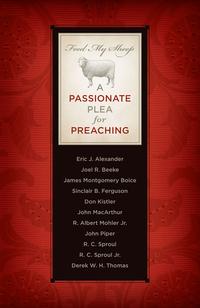
Book Review: Feed My Sheep: A Passionate Plea for Preaching

I have the great privilege of preaching a four week sermon series at my church in March. In Spanish. Though the Spanish part makes me a little nervous, after reading Feed My Sheep: A Passionate Plea for Preaching I feel much more prepared.

Feed My Sheep is an anthology with each chapter coming from some well-known names in preaching. As with most any anthology, there are some authors and subjects that are better than others. My focus here is not to dwell much on those I didn’t like, but to point out a few of that I thoroughly enjoyed.

Chapter 1: The Primacy of Preaching
Selecting Albert Mohler to grace the first pages of the book was wise. For one, he is respected, well-known, and has built his reputation on sound Biblical exposition and commentary. His chapter, “The Primacy of Preaching,” serves as a powerful introduction to the topic and lays a solid foundation for the rest of the book. The message is clear: this book is for those who believe preaching is not just a method, but a mandate.

Chapter 5: The Teaching Preacher
R. C. Sproul gives readers insight into the mind of Martin Luther. Though he has done this in other books, the practical insight of Luther in relation to preaching is helpfully drawn out here and provides a useful aid to sermon preparation.

Chapter 7: Preaching to the Heart
Sinclair Ferguson’s topic was “Preaching to the Heart.” He spends some time addressing the meaning of “heart” in the Bible, which overlaps somewhat with the mind, volition, and emotions. At first the chapter seemed to avoid dealing with preaching to the emotions, but rounded out nicely by focusing on preaching to the whole person and not just one area (mind, volition, or emotions).

Chapter 8: Preaching with Authority
The chapter about preaching with authority, by Don Kistler was short and encouraging. He is quick to point out that pastoral authority is derived authority. The call to preach with conviction and confidence in the material resonates deeply with one who is somewhat timid to step up to the podium.

Unfortunately, Kistler took some liberties and didn’t build a strong biblical argument for the specific style of preaching, but a long theological treatise and a short note of encouragement is not easily to combine into one chapter. As such, it suffers in one area, but blooms in another.

Chapter 9: Evangelistic Preaching
On the flip side, Eric Alexander’s exposition of 2 Corinthians 5:11-21 was excellent and gave real biblical authority to his chapter on evangelistic preaching. This chapter, combined with John MacArthur’s exposition from 2 Corinthians 4, gave both practical advice to preachers, but also a helpful example of biblical exposition.

Despite the all-star cast, a couple chapters were not as good. The one by James Montgomery Boice, which I was looking forward to reading, was somewhat difficult to follow and didn’t have a logical or smooth flow from passage to passage or thought to thought. R.C. Sproul, Jr. failed to do his topic much justice as it was too short and didn’t convey the same kind of zeal the other contributors had.

However, these disappointments were rather minor and the book as a whole was rather helpful and enriching. Other chapters that I thoroughly enjoyed were “Expository Preaching” by Derek H.W. Thomas and “Preaching to Suffering People” by John Piper.  The sheer number of fine contributors and fine messages makes the book worth looking over.

To buy the book, visit Ligonier.org (direct link).

If you're interested, but not sure, download a copy of the first chapter
here. It has Albert Mohler’s opening chapter and is well worth the read.

Disclosure of Material Connection: I received this book free from Reformation Trust Publishers as part of their book review program.