Showing posts with label God's Will. Show all posts

Wednesday, February 6, 2013

Book Review: Brass Heavens

Brass Heavens: Reasons for Unanswered Prayer. By Paul Tautges. Adelphi, Maryland: Cruciform Press. pp. 122. 2013. ($9.99 Paperback | $5.99 Kindle)


Have you ever had a conversation with someone and it felt as though you were talking to a brick wall? How about prayed to God and it felt as though the heavens were made of brass and nothing was getting through? Why is it that I’m not receiving an answer to my prayer? Enter Paul Tautges and his book Brass Heavens: Reasons for Unanswered Prayer.

In the introduction, Tautges summarizes the purpose of unanswered prayer this way: “[God] wants to test our faith that we might see for ourselves just how weak and dependent we are on him for all good things. His goal is nothing less than to heighten our spiritual sensitivities in order to draw us into more intimate fellowship and faithful obedience with him.” I love this explanation, and I’m certain that most believers would agree with it. But I wasn’t quite expected for the nuts and bolts of what this explanation means.

My thoughts don’t typically race to the idea that my sin could be responsible for God’s silence. I’d much rather take comfort in the thought that it just isn’t God’s timing or God’s will why a certain prayer remains unanswered. But Tautges challenges his readers with Scripture and gives us a troubling thought: perhaps it is my sin that is causing this silence from God.

Of the six reasons Tautges gives for unanswered prayer, the first five deal specifically with our sin:

  1. Pet Sins
  2. Neglected Duties
  3. Religious Sins
  4. Inconsiderate Husbands
  5. Stubborn Pride

I can’t argue with the list. There have been times when I’ve seen my prayer life has suffered because of one or more of the above. Tautges says, “In any given instance of challenge or difficulty, God may or may not be interested in changing the circumstances. But he is always interested in changing us.” Unanswered prayer, then, can call us back “into more intimate fellowship and faithful obedience with him,” when we’ve given in to sin.

However, Tautges isn’t naïve. Sin can’t account for every unanswered prayer. That’s why reason number six is so important: Testing Our Faith. It could be that our prayers are not hindered by sins in our lives. Our prayers may be good and honorable. Why then would God not answer our prayers? Again, appealing to the “it’s just not in God’s timing right now” explanation may satisfy some, I think Tautges gets a little deeper and more to the point:

[God] wants us to trust in him even when things don’t go the way we hope, or expect, or think they should. God is our loving heavenly Father who delights to come to our aid when and how it is actually best for us... There are no short-cuts to spiritual maturity. Fully developed faith can only be brought about by a long, difficult process involving trials which produce perseverance, and perseverance has an eternal reward.
Unanswered prayer will challenge our faith and cause us to grow more mature, to be more like Christ. And that will prove more precious to us than we can imagine.

I received this book from Cruciform Press for the purposes of review.

Wednesday, January 11, 2012

Newsboys and the Problem of Evil

I’ve been a big fan of the Newsboys since I discovered them back in the late nineties. I believe I have John Nawrot, my now-brother-in-law, to thank for sharing some of his music with me. I’ve enjoyed listening to the Newsboys since then and have gotten quite a few of their CDs (though now I’m going digital).

This morning I saw that the Newsboys just released the music video for their new song, “God’s Not Dead.” The song is good, and their music video certainly reflects the challenge we face today as Christians in Western society.

At one point the video shows a news reporter on a tablet computer with the large headline “How Can A Good God Allow Evil?” on display beside her.


The band member swipes his hand to show a second page with the headline “God Gave Us Freedom To Choose: Man Chose To Do Evil.”


This question is not only posed by secularists. Many Christians today struggle with how God can allow evil. It only takes one accident, one illness, one death for us to struggle with this question. Christians in the past have wrestled with this question, including Augustine, Calvin, Luther, and others. It even has its own special title in the study of theology: The Problem of Evil.

I’ve known many people who attempt to answer this question just like the Newsboys in their music video. The free choice of man is their answer. They attempt to take the focus and blame off of God and place it squarely on the shoulders of humanity. God’s love for us is so great that He chose to give us our own volition independent of Him and His will. Some assert that God knew what would happen, but others believe only an ignorant God is exempt from blame in a world full of evil.

I disagree with the headline in the music video and similar attempts to get God off the hook. The question, How can a good God allow evil? is not merely an exercise of logic. It is always personal. If I had never experienced evil in my life, I might be able to wrestle with the question only in the realm of logic, but we’ve all experienced it. There’s no escape. Rather than try to deny that we have some stake in this question, we should fully accept that we are going to be somewhat biased here.

The answer that God gave us freedom and we chose evil is not satisfactory because God still allowed it (and allows it) to happen. It doesn’t answer the question. Just because we chose to do something of our own free will doesn’t mean that God is now powerless to change or correct it. Virtually every story in the Bible chronicles God working in this world over and against the choices man has made or intends to make. If God granting human beings freedom is the highest good (that is, it is better to have free will with evil than a lack of free will with a lack of evil), then why does God work to counteract any of man’s choices, since man’s will would not be truly free?

The freedom of man’s will cannot be viewed as the highest good because God regularly acts to oppose and diminish it—most visibly in the cross. If free will is not the highest good, then we are still left with the question of how God can allow evil in the world.

I believe the answer is in the Bible. As interesting as philosophy can be, a man-made philosophy built on human logic apart from the Bible isn’t going to give us the Biblical answer to this question. Starting with human freedom as the supreme good fails to account for God’s breaching of this freedom throughout the Bible. We must start with the Bible, not with a neat little slogan that fits on a bumper sticker (or faux headline).

The answer that “God gave us freedom, we chose to do evil” makes God a distant, uninvolved deity when it comes to evil and the bad things that happen in the world. It fails to account for verses like these:

Who has spoken and it came to pass, unless the Lord has commanded it? Is it not from the mouth of the Most High that good and bad come? (Lam. 3:37-38)

I form light and create darkness, I make well-being and create calamity, I am the LORD, who does all these things. (Isa. 45:7)

Is a trumpet blown in a city, and the people are not afraid? Does disaster come to a city, unless the LORD has done it? (Amos 3:6)

Click here for an article in which I discuss items relating to the question, How can a good God allow evil?

Saturday, October 29, 2011

What Guides You: the Spirit or the Scriptures?

Someone or something has the place of first importance. In the U.S., we have many laws. There are state laws and federal laws, but the law of first importance is nothing other than the Constitution. In my family, even though many times I let my wife decide, the authority and responsibility for the decisions is mine. But, what has the place of first importance regarding our practice and belief as Christians?

Some say that the Holy Spirit has the place of first importance. Others say that the Scriptures have the place of first importance. Who’s right?

At first I understand how people can think that it’s the Holy Spirit. After all, He’s God Himself! The Bible was given by Him. Certainly the Bible, which is a product of the Holy Spirit, cannot supersede His guidance.

But there’s a problem: how do we know if something proceeds from the Holy Spirit or not? For example, I know people who have said that God confirmed to them that a friend in the hospital would get better, but that friend died a few days later. Obviously that “word” that they received was not from the Spirit. But if the friend had recuperated, how would I know if it was the word of God or if the others person had a lucky guess?

Or what about matters of faith? A Christian in the ancient church said that the Spirit had commanded that widows and widowers could not marry again and that people shouldn’t escape persecution, but seek to be martyrs. Was that really a command of the Holy Spirit?

There’s one thing we should always remember: the Spirit gave us the Bible, and He does not lie. So He’s not going to guide us against what He’s already told us. Therefore, the Scriptures should have first importance regarding our practice and belief as Christians.

What we call the guidance of the Holy Spirit can be many things—a demon, carnal desires, subconscious suggestions, or our own heart. Jeremiah 17:9 warns us: “The heart is deceitful above all things, and desperately sick; who can understand it?” There are many people who want to avoid giving account of their actions and they use the Holy Spirit as an excuse.

When we study the Bible, our slogan is “One Scripture never contradicts another Scripture.” When we look for the will of God and want His Spirit to guide us, our slogan should be “The Spirit never contradicts Scripture.” After all, He wrote it.

This article originally appeared in Spanish on my blog sanoeintachable on October 28, 2011.

Saturday, April 23, 2011

What's in the Bible? (Part 2)

This is my concluding note on Phil Vischer's What's in the Bible? kids' program. Read Part 1 here.
What’s in the Bible? According to Phil Vischer, creator of VeggieTales and his new children’s video series, Arminianism is.

An Arminian Worldview
Apparently Vischer has decided that it is better to focus on Arminianism than Christ in the Old Testament (see previous post). Arminianism is much more complex than I can cover here, and my focus is only on one tenet of Arminianism, so it isn’t as though Vischer has devoted a whole DVD to the articles of Remonstrance.

I am a Calvinist, and I have no qualms about it. If that term has excess baggage for you, check out this post to get a better idea of what I believe. I don’t think the show should teach Calvinism if that isn’t what Phil Vischer believes, but he sets up viewers to read and understand the Bible from only one interpretive frame work: man’s free will. This is unbiblical.

True, certain things can be extrapolated from the Bible based on the whole of what the Bible says about something. That’s why we talk about the Trinity. But even the theologians who debated and helped form the early creeds regarding the Trinity knew that they had to take in all the evidence if they were to use non-biblical language. But Vischer’s explanation of free will is selective. A more Biblical explanation of this topic can be addressed by looking at God’s sovereignty and human responsibility, which is not a synonym for “free will.” These things are found in the Bible and discussed together, especially in Romans 9, Ephesians 1, and other places.

While attempting to explain the fall (and man’s other sinful actions), Phil says that God has given human beings a “powerful and dangerous gift—free will.” Dangerous? For who? From the video, it seems it was dangerous for both us and God. As a result, the interpretive framework that ties the three videos together is free will to the exclusion of the sovereignty of God. And as far as the show is concerned, God didn’t have a plan of redemption until after the fall. When God created Adam and Eve, He was taking a risk.

A risk?

Does that mean God was blindsided? Shocked? Caught off guard? The show doesn’t ask or answer those questions. But the point is clear: the fall depended entirely on Adam and Eve. Not only does this encourage children to have a man-focused instead of God-focused understanding of the Scriptures, it actually twists the sovereignty of God into a potential reality, not a kinetic reality.

More to Come

I think much can be gained from What’s in the Bible?. As a parent (or soon-to-be parent), I want my children to have every opportunity to learn God’s story and have a chance to respond to the gospel. Children are drawn to media, and I plan to make use of this show and others to help my kids understand what the Bible says and teaches.

Vischer’s characters are both entertaining and educational. I’ve had friends tell me they were learning right along with their children. The content is heavy, and it is amazing what can be squeezed into a 50 minute program.

No parent should rely solely on kids’ programming, church classes, or sermons to instruct their children. Ultimately each parent is responsible for his or her child’s spiritual formation. With What’s in the Bible?, there is a definite need to give more guidance and clarification to young minds.

To what extent Phil Vischer is an Arminian will only be revealed as more episodes are aired. I may buy them if they drop down into my price threshold (yes, I am cheap). Until then, Vischer has given us enough to contemplate (and be concerned over) in the videos that have already been released.

Wednesday, February 9, 2011

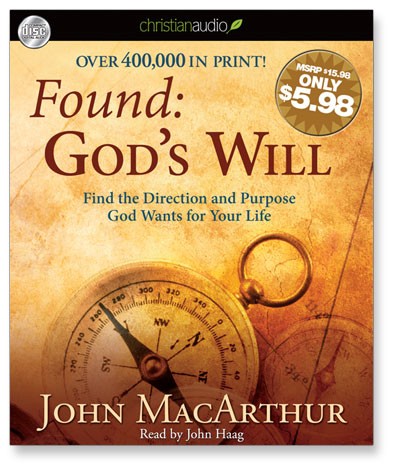
Book Review: Found: God's Will by John MacArthur

My wife and I have reviewed two of John MacArthur's books previously (here and here). This latest review is of the audiobook, Found: God's Will.

A friend of mine describes John MacArthur as to the point, no fluff. He could have been talking about his book, Found: God's Will. Compared with other books of his, this one is a bit on the short side—only 64 pages or 1.42 hours. That's not to say he doesn't cover the material well. In fact, the shortness of the book goes to strengthen his point: finding the will of God for your life is not that difficult.

MacArthur uses Scripture passages from the New Testament that specifically mention God's will and extrapolates from them what God would have you do. Specifically, he addresses God's will for you to be saved, Spirit-filled, sanctified, submissive, and suffering. The last chapter deals with God's specific will for your life in the day-to-day and even life-changing decisions you must make.

The narrator captures MacArthur's strong voice and even his sarcasm at times, which adds life to the book. Found: God's Will was a nice, short explanation of God's will that won't take long to read or listen to. If you want to know what the Bible says, this book will tell you. If you want a play-by-play explanation of what you need to do, you won't find it.

If you're looking for something a little longer on the subject, I strongly suggest you to check out Kevin DeYoung's Just Do Something. I reviewed it some months ago and liked it so much that I've purchased three print versions for gifting purposes. It was very good.

To order the audiobook, visit ChristianAudio (direct link).
To view more reviews, visit Amazon.com.
To view a preview of the book, visit GoogleBooks (direct link).

Disclosure of Material Connection: I received this book free from ChristianAudio as part of their Blogger Review Program. I was not required to write a positive review. The opinions I have expressed are my own. I am disclosing this in accordance with the Federal Trade Commission’s 16 CFR, Part 255: "Guides Concerning the Use of Endorsements and Testimonials in Advertising."

Saturday, February 6, 2010

God's Perfect Will

The following article first appeared on January 18, 2010 on sbcIMPACT!, a blog I regularly post and comment on.

*All Scripture quotations are from the English Standard Version

Two Wills

Some people like to refer to two wills in God—perfect and permissive. For instance, we know that God is “not wishing (‘willing’ in other translations) that any should perish, but that all should reach repentance (2 Peter 3:9).” We know that not everyone does reach repentance, and therefore some perish. Does this mean that God’s will is thwarted? In one sense, perhaps, but not really. It says in Daniel 4:35, “…he does according to his will among the host of heaven and among the inhabitants of the earth; and none can stay his hand…” In Job 42:2, speaking to God, Job says, “I know that you can do all things, and that no purpose of yours can be thwarted.”

In order to reconcile the apparent contradiction between God accomplishing all that He wills and something that God wills not taking place, some have proposed what is called God’s “perfect will” and God’s “permissive will.” God’s perfect will is the action or state of being that would most conform to the commands and character of God so as to bring Him pleasure. We attempt to describe our own perfect will when we say things like, “In a perfect world…” or “If I had my way…” or “Wouldn’t it be great if…” Similarly, we could impose the first phrase into a passage from 1 Peter 2:15 to show God’s perfect will: “[In a perfect world], by doing good, you [would] put to silence the ignorance of foolish people.” Nothing indicates that this is how things will necessarily turn out, and many times they don’t in Christian contexts. That lack of perfect conformity to the will of God takes us to the permissive will of God.

The permissive will of God is the action or state of being that actually occurs, whether in conformity to the commands and character of God or not. References to the permissive will of God usually deal with the issues of sin, sickness, wars, and natural disasters—things for which God doesn’t usually offer a mark of approval. Other terms are usually used to refer to the specific things that God brings about or that actually conform to His commands and character, but since they are included in the way history plays out, I include them in the permissive will of God. Why? Because we know that history is not up to par with God’s perfect will, even with God’s perfect will playing out alongside his permissive will. For instance, if a soldier accepts Christ while on a tour of duty in Afghanistan, we could say that was according to God’s perfect will (since God desires that all would be saved), but since war is part of God’s permissive will, ultimately a conversion during armed conflict would have come about according to the permissive will of God. That is an interesting observation and forms part of the basis for my dislike of the terms “permissive will” and “perfect will” in this context.

A “Hands Off” God

The terms “perfect will” and “permissive will” are inadequate for a thorough treatment of the issue of God’s will for the following reasons:

1) With the exception of the time prior to the Fall in Genesis 3, everything we could link to God’s perfect will is actually His permissive will because it was precipitated by a permissive will event in the past (like the war conversion example).

2) Following the first point, having a perfect will and a permissive will implies that God is not getting His way in the universe. It suggests that He is settling for second best, since “permissive” is necessarily not as good as “perfect.”

3) If God is settling for second best, we seriously have to question God’s ability to carry out His purposes or to question His eternal satisfaction with second best. This is a dangerous path to follow and has led some to deny of many of the attributes of God including His omniscience, omnipotence, and omnisapience (being all-wise).

4) Lastly, and perhaps most importantly, it presents us with a “hands off” God that is not as active (or perhaps as effective) as the verses in the Bible (such as in Job and Daniel) would have us to believe.

This “hands off” God presented in the perfect/permissive will is not the God of the Bible. There are many passages that present both an active and effective God. Perhaps one of the most thorough treatises on God’s activity and efficiency is in Job 38. I used to like to think that God set up the seasons and the laws that govern the universe to act in His stead, but this passage gives Him credit not only for creating the “natural laws,” but also for actively holding the stars together and for actively sending each bolt of lightening. The Bible does not paint for us a picture of an inactive God. It is not so great a thing to ask God to make the sun stand still when you know it is He who actively holds it in place. Perhaps Ephesians 1:11 sums up God’s activity and efficiency best by saying God “…works all things according to the counsel of his will” (emphasis mine).

An inactive or ineffective God is not a God who can be blamed, which is why the perfect/permissive will of God remains a popular view for many Christians today. In effect, the argument is that God has tied His hands on the issue by giving us freedom, and He has decided to let arbitrary natural laws determine the consequences of our free choices apart from His direct activity. But if that is the case, then God must have known what the result would be from the beginning. This position, while trying to protect God from blame, offers no real defense and only distracts from the question of why certain things happen to certain people. If God knew about it in advance, he certainly could have prevented it from happening.

The Active God

An active and effective God who controls and ordains everything, including who suffers from sickness, who dies in war, and the devastation of natural disasters, must also control whether or not sin will happen, who will do it, and what the consequences will be. Even someone with an Arminian base to his theology must admit that if God is omniscient and all-powerful, He could have chosen to act in such a way as to prevent any illness, war, or disaster without infringing on our “free will.” He therefore must have approved of it in some sense or it never would have happened.

Some object to this train of thought, saying that God never approves of sin nor enjoys suffering, but we are then pulled back into the issue of God settling for less than optimal or God lacking the ability to “work all things according to his will.” If God truly is working all things according to His will, then in some sense it must be God’s will that children get sick, Christians suffer, and tsunamis and earthquakes (think Haiti) strike. Romans 8:28 says, “And we know that for those who love God all things work together for good, for those who are called according to his purpose.” This verse means nothing to us if we don’t believe it was part of God’s plan for all of our life’s circumstances to turn out the way they did. If we prefer to read this verse as a comfort when we’re suffering, why is it not a comfort to us when we’re not?

Even though we don’t necessarily understand how God can ordain evil things for good, we have to trust that He does. An all-powerful and all-knowing God must have decided it was “best” or else He is denying Himself the pleasure and glory He deserves.

Allow me to explain this point. Perhaps the best example of this is the story of Joseph in Genesis. Here we see that Joseph’s brothers sold Him into slavery. While in slavery, he rose to a position of prominence and then was imprisoned for something he didn’t do. After he rose to a position of prominence by warning the Pharaoh of pending disaster, he saved his entire family from famine and faced his brothers once again, as their superior. Some preachers have said that God turned a bad situation around for good. Here is what the scripture says, “And now do not be distressed or angry with yourselves because you sold me here, for God sent me before you to preserve life. For the famine has been in the land these two years, and there are yet five years in which there will be neither plowing nor harvest. And God sent me before you to preserve for you a remnant on earth, and to keep alive for you many survivors. So it was not you who sent me here, but God. He has made me a father to Pharaoh, and lord of all his house and ruler over all the land of Egypt (Genesis 45:5-9, emphasis mine).”

The point here is not that God made the best of a lousy situation. The point is that God’s purposes are greater than the purposes of sinful and wicked created beings. In a limited sense, God is like an author, telling a story, using evil characters and good characters to ultimately bring Himself glory, only the difference is that God interacts with His creation. Must the Author carry vile intentions for His characters to carry vile intentions? Must the Author be wholly evil for His characters to be wholly evil? There is no contradiction between saying that God is good and that he willed both good and evil to occur in His story. This is partly because God exists on a different plane than His “characters,” but also because sickness, suffering, and disaster can show both God’s wrath and judgment as a holy God and God’s mercy and grace in bringing us through these trials. Ultimately this brings glory to God. And God is the one who orchestrated it. The prophet Jeremiah summed it up in Lamentations 3:37-38: “Who has spoken and it came to pass, unless the Lord has commanded it? Is it not from the mouth of the Most High that good and bad come?”

The Good God and His Perfect Will

But how can God be justified for His sovereign inclusion of these evils in His plan? Paul answers a similar question in Romans 9. He says, “You will say to me then, ‘Why does he still find fault? For who can resist his will?’ But who are you, O man, to answer back to God? Will what is molded say to its molder, ‘Why have you made me like this?’ Has the potter no right over the clay, to make out of the same lump one vessel for honorable use and another for dishonorable use? What if God, desiring to show his wrath and to make known his power, has endured with much patience vessels of wrath prepared for destruction, in order to make known the riches of his glory for vessels of mercy, which he has prepared beforehand for glory? (Romans 9:19-23).”

I used to think that Paul’s response was avoiding the question. After careful prayer and seeking, I discovered that Paul really does have an answer. God is God. Who are we to question His motives or His actions? If God is the ultimate authority in the universe, and He says that “all things work together for good, for those who are called according to his purpose,” who are we to doubt Him? I don’t think we’re called to fully understand how God has ordained everything that happens and we are responsible for our actions. But let’s not throw up half a defense and claim that God has a perfect will and a permissive will. He does have a perfect will, and He’s working all things according to its council.

Wednesday, January 13, 2010

Book Review: Just Do Something

I've recently been accepted into the ChristianAudio Reviewer's program to download some audiobooks, listen to them, and write a short review. This is definitely a book I would recommend for people wondering what God's will is for their life. The book is available at Amazon.com and the audio version is available at ChristianAudio.com (and it's not expensive, either).
Kevin DeYoung presents a practical, down-to-earth presentation of what it means to find and follow God’s will. Or should I say “make decisions?” He presents a strong and common sense argument against over-spiritualizing our directionless meandering through life and just applying scriptural principles to our decision-making. His message is simple: Just do something. Through the course of the book he explains that there’s more to following God’s will than arbitrarily doing whatever you want, but he makes finding God’s will easier and more difficult at the same time.

It is easier in the sense that we don’t have to wait for God to give us an unmistakable impression that we need to go and do something. What God has chosen to tell us about His will is evident in the Bible. It is harder in the sense that we are called to live godly lives, not to wait for God to reveal our next step to us.

The narrator reads the book the way it should be spoken. He adjusts his tone, pitch, and inflection, so a question sounds like a question, and sarcasm, well, let’s just say I love this book.

Mr. DeYoung presents his arguments and then carefully qualifies them, which I found to be a “page-turner” (so what if it’s an audio book). He’d say something and I’d think to myself, “That sounds right, but I have a reservation or two.” He’d then go on to explain exactly what he means and what he doesn’t mean, clarifying it with Scripture and clearing up misconceptions. This is a great book, especially for people who are waiting for God to show them what to do. Just do something!